
There is a pattern that repeats itself constantly in UAE facilities management: a chiller runs slightly warmer than it should for three weeks. Nobody notices. Then on a Thursday in July, it fails — at peak load, during peak occupancy, in 45°C heat. The repair call goes out, guests or tenants or staff start complaining within the hour, and the reactive maintenance bill lands at three to five times what a proactive fix would have cost.
The failure was not sudden. It was gradual. The data was there the whole time — just nobody was watching it.
That is the problem critical asset monitoring solves. Not by preventing equipment from ageing, but by making the signs of degradation visible before they become emergencies.
Why the UAE Makes This Harder Than Anywhere Else
Cooling systems consume between 70% and 85% of total energy in UAE commercial buildings — figures cited by the Gulf Organisation for Research and Development and confirmed across multiple engineering studies of the region’s built environment. No other market on earth puts this kind of sustained thermal load on building equipment for this many months of the year.
The consequence is that the degradation curve for UAE HVAC and cooling infrastructure is steeper and faster than it is in more temperate climates. A chiller that might show early warning signs over six months in a European facility can reach the same point in three months in Dubai. Equipment simply works harder here, and working harder means wearing faster.
Buildings are also getting scrutinised more closely than ever. Dubai has committed to retrofitting 30,000 buildings by 2030 under an AED 30 billion programme targeting a 30% reduction in energy consumption — and the buildings sector accounts for roughly 28% of the UAE’s total emissions. Facility managers are now operating in a regulatory environment where energy performance is not a nice-to-have but a tracked, reported, and enforceable obligation.
Against this backdrop, running a large facility without asset monitoring is a compounding risk. It is not just the cost of the failure itself. It is the energy wasted by equipment running inefficiently in the weeks before it fails. It is the emergency contractor rates. It is the reputational damage in a hospitality or healthcare context where occupant experience is non-negotiable. And increasingly, it is the compliance exposure.
What Gets Monitored — and Why It Matters Which
Not everything in a building is a critical asset. The practical question is: which assets, if they fail unexpectedly, would cause the most damage — financially, operationally, or to the people inside the building?
For most UAE commercial and institutional facilities, the answer is consistent:
- Cooling and HVAC systems — the highest-consequence failure in the UAE climate; thermal comfort collapses within minutes of a chiller trip
- Backup power — generators and UPS systems — critical for data centres, hospitals, hotels, and any facility where a power interruption cannot be tolerated
- Electrical distribution — voltage irregularities, overloading, and power factor degradation are quiet precursors to expensive failures
- Pumps and motors — vibration patterns change measurably before bearings fail; this is exactly the kind of signal continuous monitoring captures
- Fire suppression and life safety systems — regulatory compliance requires these to be in constant working order; sensor-based monitoring provides the audit trail to prove it
- Lighting control systems — often overlooked, but a significant contributor to both energy waste and maintenance cost at scale
AIA’s critical asset monitoring approach begins by mapping which assets carry the highest operational risk for each specific facility — a hospital has a different criticality profile than a logistics warehouse or a commercial tower. Monitoring is then designed around that profile, not applied uniformly regardless of context.
What the System Actually Does
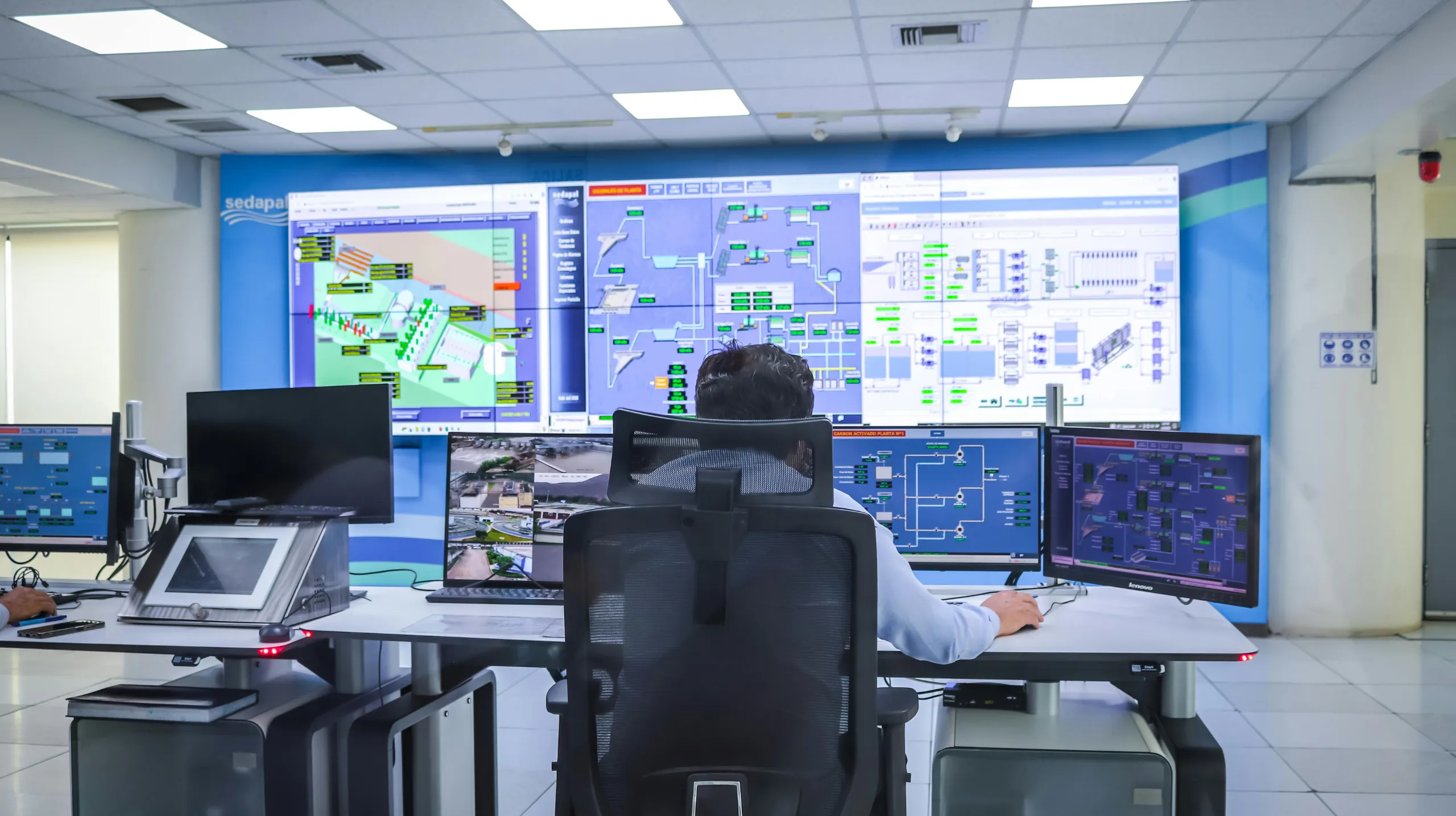
The hardware layer is straightforward: non-intrusive sensors installed on and around each monitored asset, measuring the physical parameters that indicate how that asset is performing — temperature, current draw, vibration, pressure, humidity. These readings are transmitted continuously to a central platform.
The value is in what happens next.
Rather than delivering a raw feed of data that a facility team would need to interpret manually, AIA’s platform processes readings against predefined thresholds and trend models. When a motor starts drawing more current than its baseline — not enough to trip a breaker, but enough to suggest a developing fault — the system flags it. When a cooling unit’s discharge temperature starts trending upward over several days rather than a single anomalous reading, the system identifies the pattern and generates an alert.
This distinction between point-in-time anomalies and developing trends is what separates genuinely useful asset monitoring from a system that generates noise. A single unusual reading might be meaningless. The same reading recurring and worsening over two weeks is a maintenance event waiting to happen.
AIA’s platform delivers: segregated alarms analysis so the right alert reaches the right team, historical data analytics for trend identification, manufacturer KPI profiles so equipment is benchmarked against its own specifications rather than generic norms, and FM team performance reporting so facility managers can track response times and outcomes.
The output of all of this is not a dashboard for its own sake. It is the ability to schedule a maintenance visit during a planned downtime window rather than scrambling to find a contractor on a Friday evening in summer.
The Integration That Multiplies the Value
Asset monitoring in isolation is useful. Asset monitoring integrated into a broader building management system is considerably more powerful.
When a monitored chiller shows signs of elevated load, an integrated system does not just send an alert — it cross-references the reading with current occupancy data, outdoor temperature conditions, and the chiller’s maintenance history. A facility manager receiving that alert gets context, not just a number. They know whether this is expected given current conditions, or whether it signals something that needs attention today.
For UAE facilities with energy reporting obligations, the integration with energy data management systems adds another layer: asset performance data feeds directly into consumption reporting, so inefficient equipment is visible not just as a maintenance risk but as an energy cost line. That is a conversation that lands very differently in a board-level sustainability review than a maintenance log entry.
The Economics of Monitoring vs. Not Monitoring
The business case for critical asset monitoring rests on a single observation: reactive maintenance is always more expensive than proactive maintenance, and the gap widens in proportion to how critical the asset is.
Emergency contractor call-outs in the UAE carry significant cost premiums. Parts sourced urgently rather than planned cost more. And the downstream costs — operational disruption, lost revenue, reputational damage, tenant complaints — are rarely captured in the maintenance budget but are very real.
Condition-based maintenance, which asset monitoring enables, removes both the waste of replacing components that still have useful life and the danger of missing components that are approaching failure. Over a monitored asset portfolio, this optimisation consistently delivers measurable reductions in overall maintenance spend — alongside the harder-to-quantify but equally real benefit of extended asset lifespan.
AIA allows clients to focus on their core business, not technology issues. The system provides reliability through proactive maintenance, productivity, and a healthy working environment.
If you manage a facility in the UAE and your maintenance approach is still primarily reactive, the question worth asking is not whether you can afford asset monitoring. It is whether you can afford not to have it. Talk to AIA.
Frequently Asked Questions
1. What is critical asset monitoring?
Continuous, sensor-based tracking of high-value equipment that detects early signs of degradation — before a fault becomes a failure.
2. Which assets qualify as “critical” in a UAE facility?
Typically: cooling systems, backup power, electrical distribution, pumps, fire suppression, and life safety systems — any asset whose unexpected failure causes operational, financial, or safety consequences.
3. Why is asset monitoring particularly important in the UAE?
Because cooling alone accounts for 70–85% of building energy consumption here, equipment works harder and degrades faster than in cooler climates — making early detection more valuable, not less.
4. Can asset monitoring integrate with an existing BMS?
Yes — AIA designs all monitoring deployments to feed into an existing building management system, giving facility managers one unified operational view.
5. What makes it different from just checking equipment on a schedule?
Scheduled checks happen at fixed intervals regardless of asset condition; monitoring is continuous, catching developing faults between visits that a monthly inspection would miss entirely.
6. How quickly are alerts sent when something is wrong?
Typically within seconds of a threshold being crossed, with alert routing and escalation rules configured during commissioning to reach the right people immediately.
7. Is this suitable for smaller facilities, not just large towers?
Yes — the scope is scaled to the facility. A single commercial floor or a mid-sized warehouse benefits from the same logic as a large mixed-use tower.
8. Does it help with regulatory compliance?
Yes — continuous timestamped performance logs satisfy UAE inspection requirements for fire safety, electrical systems, and environmental standards, and provide an audit trail without additional manual documentation.
9. What does implementation involve?
Sensor installation, platform configuration, threshold calibration, and commissioning — typically four to eight weeks for a mid-sized commercial building from first survey to go-live.
10. What ongoing support does AIA provide after deployment?
Real-time monitoring, alarm management, periodic health checks, performance reporting, and predictive maintenance recommendations — the system stays aligned with how the facility operates.
Comments are closed.